CS4NorCal's Professional Learning Model
About the Professional Learning Model
The two-year CS4NorCal professional development program, illustrated below, provides a sustained, cohort-based learning experience for educators, preparing them to teach dedicated computer science courses or integrate computer science into their existing subjects. The model is structured around a repeating cycle of a 30-hour immersive workshop each summer (18 hours for elementary), followed by 24 hours of collaborative support sessions throughout the academic year (12 hours for elementary).
In the first year, teachers build a strong foundation by focusing on a specific curriculum, such as CS Discoveries or Exploring Computer Science. The second year offers a flexible pathway, allowing educators to either 1) deepen their expertise in their initial course through taking Equity Minded Instruction in CS or CS Integration, 2) explore specific course-related CS Integrated curricula like Bootstrap Alg I or II, or 3) learn an additional CS course to further their school’s CS pathway offerings.
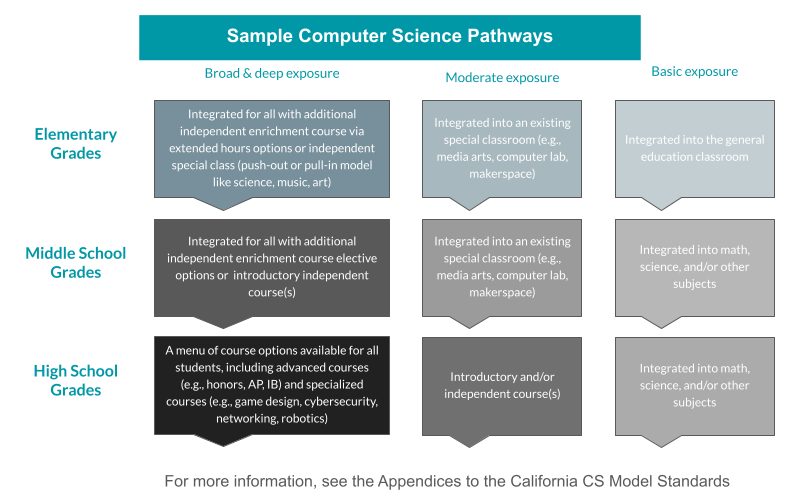
The ultimate goal of this comprehensive training is to empower schools to build a robust and articulated K-12 computer science pathway. The pathway framework the PL was based on will advance students from introductory courses like CS Fundamentals in elementary grades, through exploratory courses in middle school, and into advanced high school offerings like AP Computer Science or Cybersecurity.
|
YEAR 1 |
|
|
Summer: 30 hours of PL on specific CS Courses Options include:
|
Academic Year: 24 hours of just-in-time workshops Topical and timely support for the implementation of the curriculum from the summer’s professional learning |
|
YEAR 2 |
|
|
Summer: 30 hours of PL on specific CS courses or CS application in other subjects Options Include:
|
Academic Year: 24 hours of workshops supporting CS implementation Course-specific support on the implementation of curriculum from the summer’s professional learning; or, for summer participants in Equity-Minded Instruction in CS or CS Integration advancement to the Implement for Impact workshops |
PL Program Supports the Development of CS Pathways
 Workshop Descriptions
Elementary for Computing, Year 1, explores computer science concepts and teaching methods using model lessons that connect computational thinking to language, culture, and self-expression. Participants will create a personalized plan for teaching CS and can attend future sessions on integrating it with math and science.
Topics included:
-
Semantic Waves, Concept Maps, and Cognitive Load Theory
-
Hello Ruby and CS First Curriculum Examples
-
CS Integration in Math and Science
-
CS related Pedagogical Strategies
Elementary for Computing, Year 2, guides participants to reflect on their past computer science teaching while exploring new concepts, English/Language Arts integration, and culturally responsive practices. Educators will create an expanded personalized teaching plan, with future workshops offering additional strategies for core subject integration.
Topics included:
-
Fostering a CS Identity in Students
-
Implementation Plan Reflection
-
CS Integration in English Language Arts
Computer Science Principles is an introductory course for grades 10-12 that introduces the foundational concepts of computer science while challenging students to explore how computing and technology can impact the world. This course can be taught as an AP or non-AP class and requires a full year to teach (or 100+ course hours). Participants can expect a collaborative, participant-centric approach with one cohesive set of resources.
Topics included:
-
Exploration of computer science through real-world problem-solving.
-
Engagement from diverse voices through high-quality explainer videos.
-
Open-ended projects encouraging creativity and personalized learning.
-
Aligned with AP® CSP standards ensuring rigorous, accessible education.
CS Discoveries is an introductory computer science course that empowers students in grades 6-10 to create authentic artifacts and engage with computer science as a medium for creativity, communication, problem solving, and fun. CS Discoveries can be taught as a 1 or 2 semester course (or 50+ course hours).
Topics include:
-
Artificial Intelligence
-
Data
-
Web Design
-
Physical Computing
-
App Design
-
Games and Animations
-
Art and Design
-
Programming
Exploring Computer Science (ECS) was developed in response to previous research, detailed in Stuck in the Shallow End (Margolis et al., 2008), that identified disparities in CS learning opportunities that fall along race and socioeconomic lines. The ECS curriculum is structured to facilitate inquiry and equity-based instructional practices for grades 9-10. The curriculum aligns well with college preparation coursework as well as Career and Technical Education (CTE) pathways including: Information Technology, Engineering and Design and Arts, Media and Entertainment Technology.
Unit topics include:
-
Human-Computer Interaction
-
Problem Solving, Programming
-
Data & Computing, Robotics
-
E-Textiles (optional)
CS Awesome is a College Board-endorsed curriculum for AP CSA in Java, following the AP CSA new CED standards for 2025. The AP CSA course is compatible with many CS1 courses at colleges and universities. The course emphasizes both object-oriented and imperative problem solving and design using Java, a text-based language.
The goals of CS Awesome are to support the transition of students and teachers from AP CSP to AP CSA and to prepare students and teachers for success on the AP CSA exam, while fostering problem-solving, algorithmic, and object-oriented design skills through creative interactive coding activities.
CS practices include:
-
Design Code
-
Develop Code
-
Analyze Code,
-
Document Code and Computing Systems
-
Use Computers Responsibly

Bootstrap Algebra I teaches computer programming that works just like the math in the book, and curriculum and pedagogy based on best-practices in math education. The course lets math teachers build on what they already know, with rigorous introductory programming that reinforces and improves students' math outcomes. The curriculum is aligned to National and State Standards for Mathematics, as well as the CSTA standards and K12CS frameworks and can be taught as a separate, standalone Computer Science class or integrated into a mainstream math class delivered by a math teacher with no prior CS experience.
Bootstrap Algebra II is a series of standards-aligned modules that can be implemented as part of a mainstream Algebra II or Integrated Math III course or used to bring the core content of Algebra II into a Data Science course. Just as “line of best fit” can be used to motivate a discussion on linear functions in Algebra I, scatter plots with exponential, logarithmic, or trigonometric relationships can be used to motivate those same functions in Algebra II/Integrated Math III. In this workshop, educators will engage in lesson materials designed to ground core Algebra II concepts in real world data analysis! No prior coding experience is necessary.
Bootstrap Data Science features evidence-based, integrated materials for a variety of subject matter for grades 7-12 to leverage students' curiosity about the world around them and inspire real data analysis and original research.
Topics included:
-
Data visualization
-
Measures of center and spread
-
Programming
-
Linear regression
Computer Science Integration, a hands-on professional learning course, will empower your students with innovative problem-solving skills! Through the avenue of Work-Based Learning (WBL), you will engage in using the Computer Science Standards to investigate and solve problems in the world around you. We will be using the physical computing device (micro:bit) and modeling to apply measurement and data analysis for making safe decisions regarding natural and/or engineered phenomena.
Topics include Earthquake Safety, Water Quality, Internet of Things, Modeling with Mathematics and many more.
Equity-Minded Instruction in CS provides K-12 teachers with equity-focused professional learning experiences and research-based tools so they are equipped to embrace diversity and focus on offering equitable access to, participation in, and experiences of CS in their schools and classrooms.
Topics included:
-
Implicit Bias
-
CASEL’s SEL Framework
-
CS Equity Guide Jigsaw
-
Thinking Routines
-
Stuck in the Shallow End Book Activity
-
CS Data Tool Exploration
-
Universal Design for Learning
-
Removing Barriers
Implement for Impact is an engaging four-day workshop designed to transform your classroom with a comprehensive project-based learning framework. Throughout our sessions, participants will discover how to design authentic learning experiences that connect students directly to real-world challenges and professional practices. The workshop will showcase Agile project management strategies to foster student collaboration and integrate cutting-edge topics like artificial intelligence and cybersecurity into your curriculum. This series culminates in learning how to guide students in professionally curating and showcasing their work for a public audience. Participants will leave with a complete toolkit to implement meaningful projects from initial concept to final exhibition.
Topics Covered:
-
Project-Based Learning (PBL) Design
-
Agile Project Management in the Classroom
-
Integrating Emerging CS Concepts
-
Artificial Intelligence & Cybersecurity as Project Themes
-
Fostering Student Collaboration and Adaptability
-
Creating Authentic, Real-World Projects
-
Student Work Exhibition and Presentation